

TRECOVERY BY TUNGTEK / SERVICES
SAN Data Recovery
SAN data spans several layers: storage, LUNs, datastores and virtual machines. TUNGTEK works with IT to identify the affected layer and prioritize data essential to business operations.
Situations that need assessment.
Inaccessible LUNs or storage pools
Distinguish connection issues, access mapping problems and actual data faults before intervening in the storage system.
Lost, damaged or accidentally formatted datastores
Identify affected volumes and the change history; avoid creating new datastores or writing to the affected regions.
Virtual machine errors or lost VMDK/VHDX files
Assess the storage chain from the underlying system to virtual disk files. Prioritize important virtual machines and business data.
Controller faults or underlying RAID failures
Configuration diagrams, drive status and system logs are needed to establish the damage scope before reconstructing data structures.
Our approach to the data.
Work with IT to isolate affected LUNs and related systems; agree on limiting writes and preserve existing logs and configuration. Assess available copies or snapshots before deeper processing.
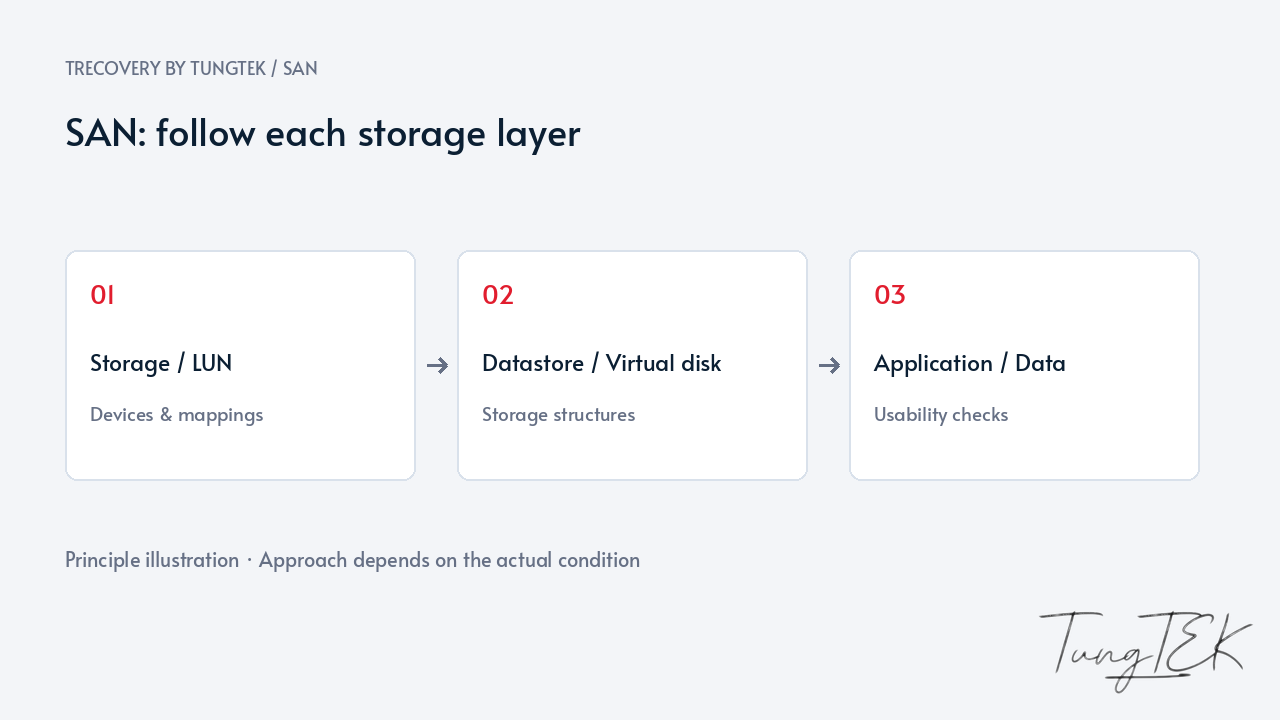
Where feasible, analyze a copy: storage/RAID → LUN → datastore → virtual disk → contained data. Agree on intake and handover milestones according to the system structure, capacity and urgency.
Scoping storage layers and business priorities
Intake covers the storage array, controllers, disk groups, LUNs, host mappings and consuming platform. Transport or mapping faults do not automatically establish data loss; conversely, a visible LUN does not prove the integrity of its file system.
TRecovery works with IT to scope the source, safe copies or snapshots and destination capacity. Thin provisioning, snapshots and encryption require configuration-specific analysis. Do not initialize LUNs or force rebuilds as an access experiment.
Extraction order follows agreed business priorities such as ERP, databases, file servers or virtual machines. Output is validated against content and application recovery needs, with checked data and remaining exceptions documented before handover.
Frequently asked questions
Should all drives be removed immediately?
Discuss the topology and symptoms first. Some faults concern transport or host mapping; removing drives without recording the configuration can complicate assessment.
Can just one VM or LUN be extracted?
A priority scope can be defined around required data, but feasibility depends on storage layers and metadata. Assessment is needed before agreeing on the approach and milestones.
Can snapshots replace recovery work?
A safe snapshot or backup may offer an appropriate restore path. Verify its scope, timestamp and integrity; a snapshot on the affected system is not automatically an independent copy.
Updated October 14, 2026