


TRECOVERY BY TUNGTEK / SERVICES
Ransomware Data Recovery Assessment
After a ransomware incident, recovery planning starts by establishing what data actually remains. TRecovery provides RFC — Ransomware Fast Check assessment of samples, backups and priority data, without promising decryption before technical evidence is available.

UNDERSTAND THE CONDITION
Situations requiring assessment
Renamed files will not open
Documents, images or databases have unfamiliar extensions and applications cannot read their contents.
A ransom note appears
The system contains a ransom note, contact details or threats from the attacker.
NAS or VM storage is affected
Shared folders, virtual disks or storage areas are unusable following the incident.
Backups do not meet the need
Copies are affected, do not cover the required point, or have not been verified by restoration.
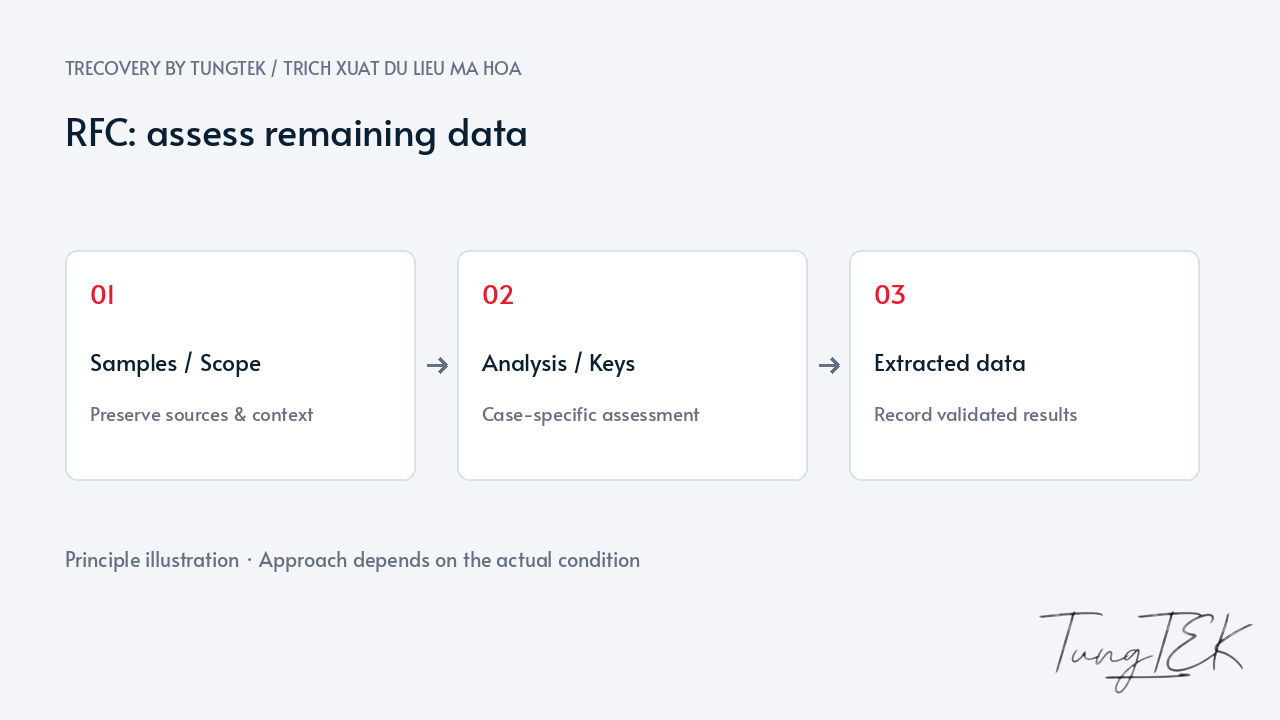
RFC establishes scope and evidence
An extension or name in a ransom note does not establish a ransomware family. RFC examines samples, file structures, system scope and incident context to direct assessment.
You identify priority data and available copies. Findings distinguish encrypted, damaged, readable and unresolved material; attacker threats are not treated as verified facts.
Contain the incident and preserve sources
Coordinate isolation with your administrator, limit spread and avoid overwriting sources. Keep affected files, notes, logs and backups; avoid mass testing of unknown decryptors.
Malware removal and data recovery are different tasks. Agree on samples, access and communication channels; do not post sensitive files publicly or send them externally just to test identification.
Assess recovery paths supported by evidence
We assess usable backups, pre-incident copies, remaining data and official decryptors when their conditions apply. A variant-specific tool does not automatically cover every file with the same extension.
We do not promise to break AES or provide a decryptor for every family. Readability needs file-specific checking; even suitable keys/tools require copy-based testing and result validation.
Verify results and restore into a clean environment
Renaming files does not prove recovery. Documents, applications and priorities need checking. Partial results must describe limitations so you can decide how to use them.
Operational restoration needs entry-point remediation and a clean environment to avoid reinfection. Specialist guidance and ransomware intake information are available at CuuDuLieuMaHoa.com; scope is agreed after assessment.
Frequently asked questions
Does the extension establish decryption capability?
No. Samples and tool conditions matter. Variants may share an extension; a family name does not establish an available key for your case.
Is assessment possible without a decryptor?
Backups, older copies and remaining data can be assessed. Options vary by system/file type; this is not a promise to recover all encrypted data.
Is the incident over once files open?
No. Data validation and entry-point remediation remain necessary. Recovery alone does not establish that the attack or possible exposure has been resolved.
Technical references
CISA — StopRansomware response and recovery guidance
No More Ransom — Available decryption solutions and limitations
CuuDuLieuMaHoa.com — Hướng dẫn chuyên sâu và tiếp nhận ransomware
Updated October 14, 2026